
🌍 GDPR for Security Teams: Going Beyond Consent and Privacy Policies
By James K. Bishop, vCISO | Founder, Stage Four Security
📜 GDPR at a Glance
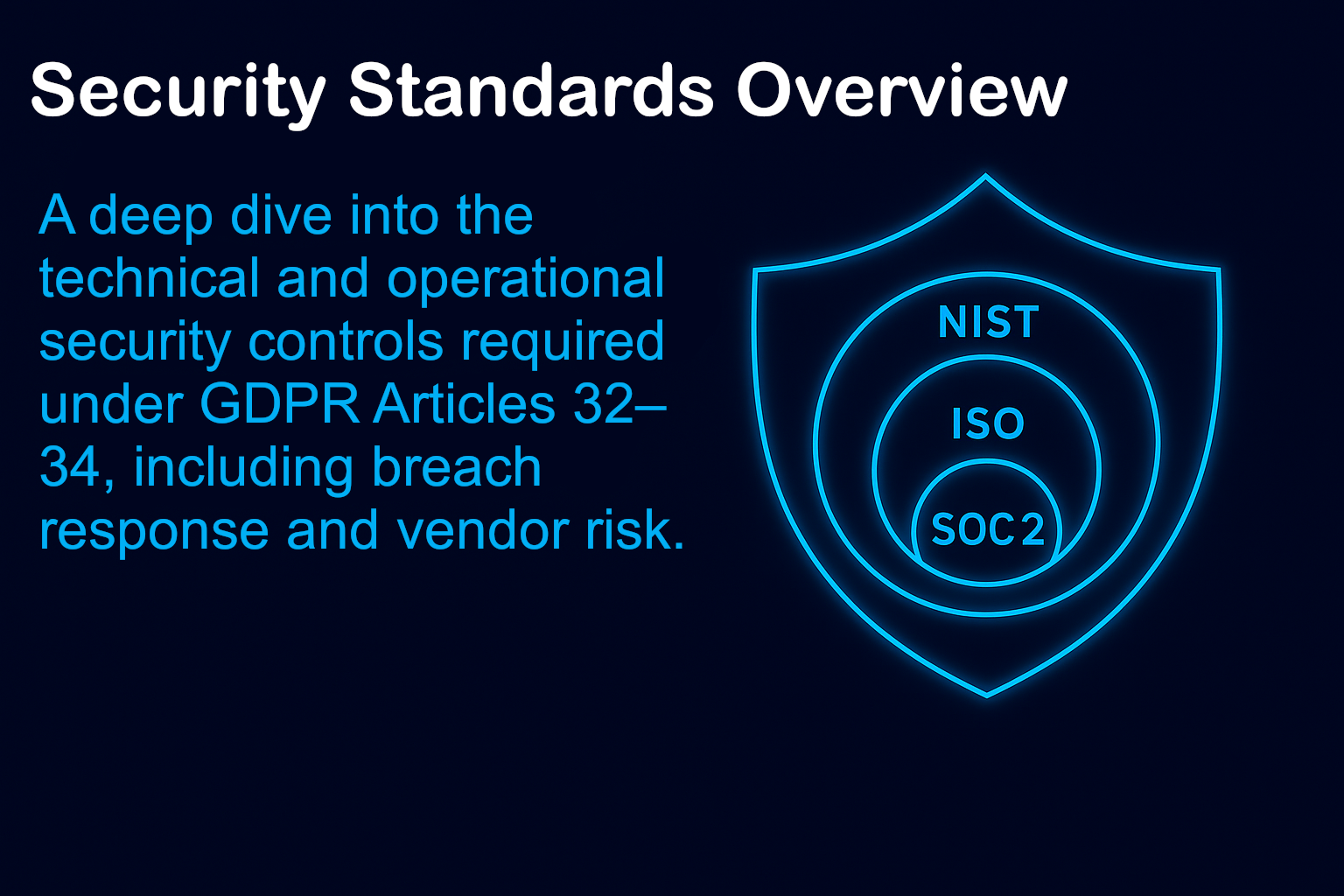 The General Data Protection Regulation (GDPR) is the EU’s comprehensive data privacy law, but it’s more than just a legal checkbox. Articles 5 and 32–34 impose real, enforceable security obligations on organizations—requiring teams to protect personal data “by design and by default.”
Who it affects: Any company that processes personal data of individuals in the EU, regardless of where the company is based. That includes SaaS platforms, cloud services, marketing tech, and third-party data processors.
🔐 Article 32 – Security of Processing
GDPR requires organizations to implement “appropriate technical and organizational measures” (TOMs) to ensure the confidentiality, integrity, and availability (CIA) of personal data. This isn’t vague—Article 32 spells out examples:
- Encryption of personal data
- Pseudonymization (tokenization, anonymization where possible)
- Access controls and role-based permissioning
- Backup and availability measures (disaster recovery, fault tolerance)
- Regular testing, assessment, and evaluation of the effectiveness of security controls
These are not optional—failure to implement adequate security can result in fines up to €10 million or 2% of global annual revenue, whichever is higher.
⏱️ Article 33 – 72-Hour Breach Notification
If you experience a breach involving personal data, you have 72 hours to notify a supervisory authority—unless the breach is unlikely to result in a risk to individuals. The clock starts when you become “aware” of the breach, not when you’ve confirmed every detail.
What security teams must prepare:
- A process to detect and escalate security incidents
- Internal decision-making workflows (including legal and DPO)
- Evidence of containment, impact, and corrective actions
- Ability to determine whether data subjects must be notified (Article 34)
Many breach investigations miss this window—not because of malice, but because there’s no streamlined plan in place.
🧱 Article 25 – Data Protection by Design and by Default
This principle requires security and privacy to be embedded into systems and workflows—not tacked on later. “By default” means collecting only the minimum data necessary, with the least access and retention possible.
Technical enforcement includes:
- Minimal default permissions (least privilege)
- Short data retention timelines enforced via TTL or lifecycle policies
- Input validation and secure software design (especially for forms, APIs, cookies)
This is where GDPR aligns well with secure software development and modern DevSecOps practices.
🌐 Article 28 – Vendor Risk Management
If you use third-party services (cloud providers, marketing tools, payment processors) to process personal data, you’re required to have written contracts that bind them to GDPR-compliant security practices.
These contracts (called Data Processing Agreements or DPAs) must include:
- Instructional scope (you control what they can do with data)
- Security controls (technical and organizational measures)
- Notification obligations in case of a breach
- Audit rights and subprocessor transparency
Security teams should collaborate with procurement and legal to vet cloud vendors and ensure their platform architecture enforces those terms in reality—not just in paperwork.
📊 Data Minimization and Lifecycle Management
GDPR doesn’t just focus on what you collect—it governs how long you retain it, how you dispose of it, and how it’s stored. These are foundational security practices:
- Set automatic expiration or deletion policies for stale or orphaned personal data
- Use lifecycle tagging in cloud storage (e.g., S3, Azure Blob)
- Ensure logs and backups are included in your deletion strategy
Every additional record is a liability in a breach. Minimizing exposure is a security control.
🛠️ Practical Tools That Support GDPR Compliance
You don’t need to reinvent your tech stack. Here’s what many security teams already use to align with GDPR requirements:
- Cloud-native encryption at rest and in transit (AWS KMS, Azure Key Vault)
- SIEM for audit trails (Splunk, Sentinel, Chronicle)
- MFA and SSO for identity and access control
- Data classification and tagging tools (Purview, BigID, or even custom scripts)
- DLP tools to restrict sensitive data movement
Most of GDPR’s security requirements align with good Zero Trust and cloud security hygiene—it’s about tying those controls back to legal obligations and proving it.
📣 Final Thought
GDPR isn’t just for privacy lawyers. For security teams, it’s a framework for resilient data protection and a mandate for operational maturity. If your platform handles EU data, you don’t just need to protect it—you need to prove that protection is intentional, ongoing, and documented.
Need help implementing GDPR-ready security controls, evidence workflows, or vendor risk programs? Let’s talk.